

At the recently held XVII International Symposium on Biological Control of Weeds (ISBCW), organised by the New Zealand Bioeconomy Science Institute, held in Rotorua, Pacific island voices were front and center. For nations on the frontline of invasive species impacts, participation in this global gathering was not just valuable, it was vital.
Invasive weeds threaten food security, biodiversity, and climate resilience across the Pacific, and the symposium offered a rare opportunity for island representatives to learn from international experts, share their own experiences, and build networks that will strengthen regional responses.
Pacific representatives from Fiji, Papua New Guinea (PNG) and Vanuatu had an opportunity to present on the work their respective countries are doing in the field of Natural Enemies during the ISBCW session on Classical Biological Control (CBC) in developing countries.
Natural Enemies are a critical, cost-effective and sustainable method for managing invasive weeds in developing countries, particularly where resources for chemical or mechanical control are limited. In these regions, where livelihoods depend heavily on agriculture, Natural Enemies help protect biodiversity and reduce the impact of invasive species that can reduce crop yields, threaten livelihoods and ecosystem services.
From Vanuatu, Ms Leisongi Bulesulu from the Department of Biosecurity presented on research showcasing how they are improving the beef industry in Vanuatu through biological control of invasive weed species and how invasive weed management is directly linked to the beef industry, with biocontrol improving pasture quality and supporting rural communities.
The Department of Biosecurity Vanuatu Plant Health team, operating under the Ministry of Agriculture and Rural Development, Livestock, Forestry and Biosecurity has worked in partnership with scientists from the New Zealand Bioeconomy Science Institute’s Manaaki Whenua-Landcare Research Group, who are the technical lead of the PRISMSS Natural Enemies-Natural Solutions programme, to implement biocontrol solutions to manage invasive weeds that threaten biodiversity, agriculture, and rural livelihoods.
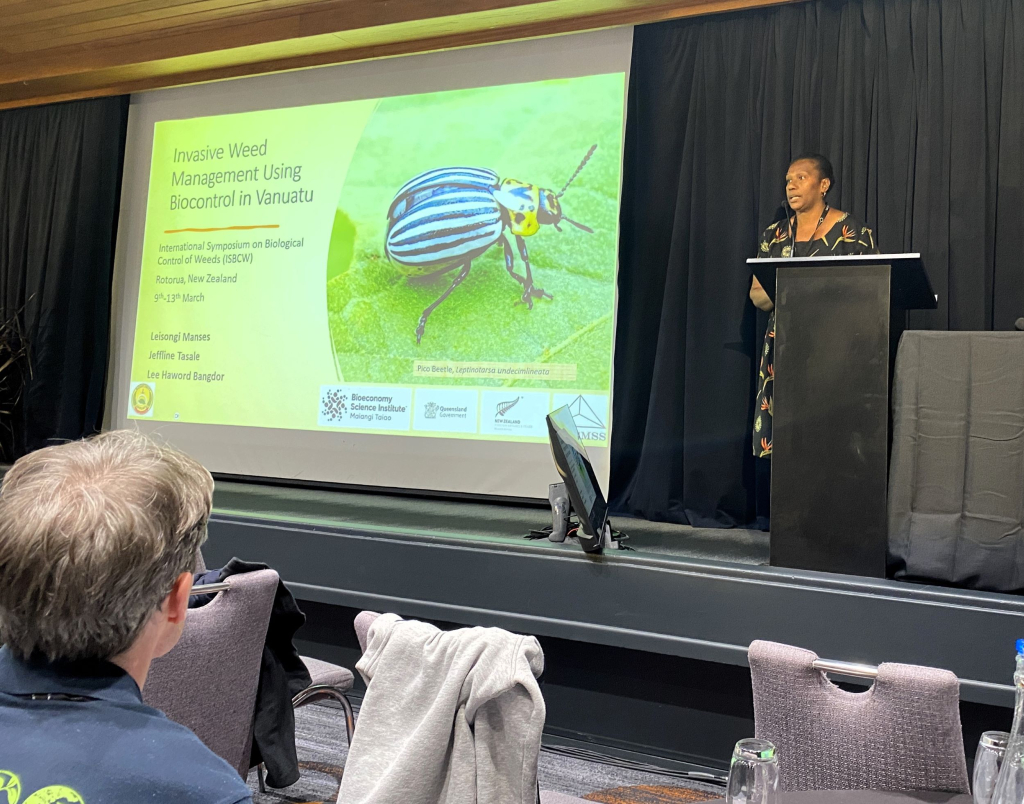
“The project focuses on introducing host-specific natural enemies to suppress weed growth and reproduction to reduce reliance on chemical herbicides, restore degraded ecosystems, and support more resilient land management practices,” said Ms Bulesulu.
The program reflects a broader commitment to ecological restoration and sustainable agricultural development through nature-based solutions and has already yielded some impressive results,” she further added.
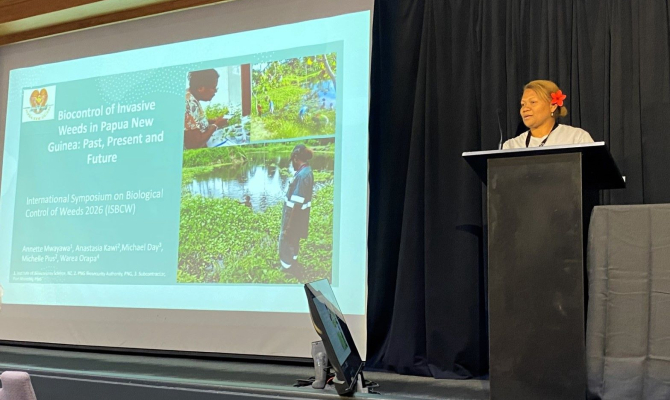
Ms Michelle Pius from the Papua New Guinea (PNG), National Agriculture Quarantine Inspection Authority presented an overview of research on their weed biocontrol efforts, stressing the need to build national capacity and strengthen partnerships.
PNG has one of the longest and most active histories of weed biocontrol in the Pacific, with 19 agents released against 12 weed species. Early successes date back to the 1980s, however, activities have stalled since 2008, and there is currently no ongoing weed biocontrol work in PNG, as capacity and priorities have shifted to other areas.
“Weed problems continue to be significant in PNG, affecting agriculture, biodiversity, and rural livelihoods. Many potential agents identified for the Pacific remain under-utilised in PNG,” said Ms Pius.
“The presentation paper reviews the history and status of weed biocontrol in PNG, examines barriers to programme continuity, and proposes a pragmatic, phased roadmap to revive and expand biocontrol work in the country.
Ms Aradhana Deesh from the Fiji Ministry of Agriculture & Waterways presented on a research paper titled Weed biocontrol in Fiji with an analysis of past impacts, current projects and future directions.
Participants attending the paper presentation session learnt how classical weed biocontrol in the Pacific, initiated in 1911, is a critical tool for safeguarding agriculture and native ecosystems. Fiji, in recent years, has released 30 agents against 11 weed species. This approach has delivered durable, cost-effective control, reducing reliance on herbicides.
This approach reflects strengthened institutional capacity and the value of international partnerships. Looking ahead, the future efficacy of biocontrol in Fiji depends on sustained investment in key infrastructure particularly quarantine and diagnostic facilities, robust post-release surveillance, and the integration of biocontrol into broader Integrated Weed Management strategies.
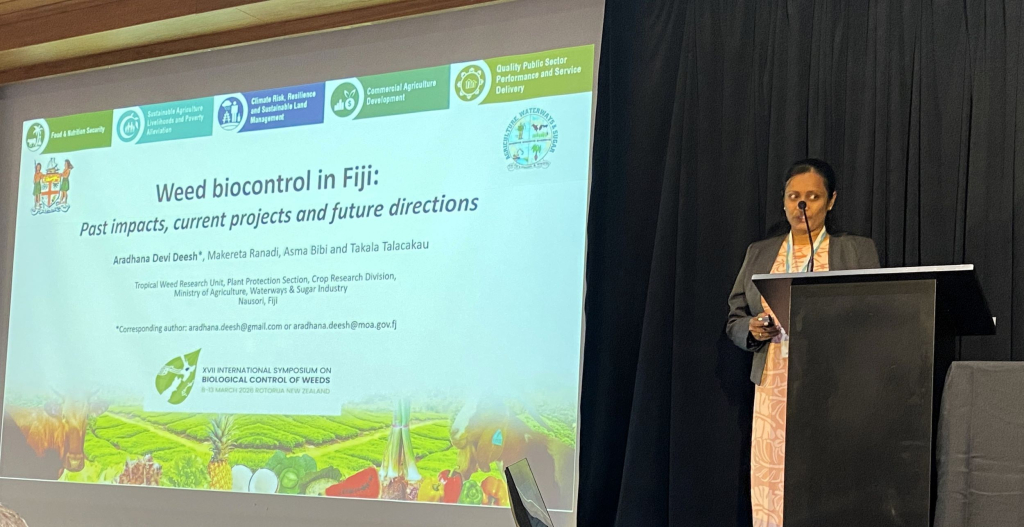
While concluding her presentation Ms Deesh highlighted that “by combining scientific rigour, regulatory safeguards and local knowledge, Fiji’s programme exemplifies a sustainable pathway for managing invasive weeds across the Pacific islands.”
At the ISBCW session, Ms. Asma Bibi from the Fiji Ministry of Agriculture presented research on Holophygdon melanesica, a Melanesian lace bug identified as a promising biocontrol agent for the invasive vine Epipremnum aureum, commonly known as taro vine in Niue.
“Invasive plants pose a major threat to Pacific islands, where their rapid spread often overwhelms native ecosystems. Taro vine is particularly destructive, a fast-growing climber that smothers forests, displaces understory plants, and aggressively colonizes cyclone-disturbed areas,” said Ms. Bibi.
Participants that attended the session were informed that the lace bug H. melanesica, native to Fiji, has shown strong potential as a biological control agent due to its close association with the target weed. To assess its safety and effectiveness, containment no-choice tests were conducted across selected Araceae species, evaluating feeding, oviposition, and development.
“The introduction of this Melanesian agent to address a Polynesian problem underscores the value of regional collaboration in agent selection and highlights the Pacific’s growing leadership in invasive weed management,” said Ms. Bibi while concluding her presentation.
Ms. Makereta Ranadi from the Fiji Ministry of Agriculture and Waterways presented research on the prevalence and life-table studies of Calligrapha pantherina, a leaf-feeding beetle introduced to suppress Sida acuta.
Sida acuta, native to Central America, has become a serious invasive weed in Fiji, reducing both crop yields and livestock productivity. In 1997, C. pantherina was introduced from Papua New Guinea as a biological control agent. Field surveys across Viti Levu, Taveuni, Kadavu, Gau, Koro, Beqa, Ovalau, and parts of Vanua Levu in Fiji confirmed the beetle’s dispersal up to 5 km from release sites, with significant reductions in weed populations observed.
Participants attending the session were informed that to support mass rearing, laboratory studies were conducted under controlled conditions between 2017 and 2018. These studies identified critical points for intervention and improved overall yield during production.
“Findings confirm that C. pantherina remains an effective and sustainable biological control agent for S. acuta in Fiji, supporting ongoing efforts to protect agricultural productivity and strengthen ecosystem resilience,”,concluded Ms. Ranadi.
Pacific participation at ISBCW was made possible through the support of the Secretariat of the Pacific Regional Environment Programme (SPREP) led Pacific Regional Invasive Species Management Support Service (PRISMSS). Funding was provided by the New Zealand Ministry of Foreign Affairs and Trade and the United Kingdom International Development.
Beyond enabling attendance, PRISMSS is helping countries align invasive species management with broader climate resilience strategies, ensuring that the knowledge gained at ISBCW translates into practical action on the ground.
About PRISMSS: The Pacific Regional Invasive Species Management Support Service (PRISMSS) is a service designed to facilitate the scaling up of operational management of invasive species in the Pacific. The SPREP Centrre of Excellence, PRISMSS brings together experts to provide support within the Pacific region with a focus on protection of indigenous biodiversity and ecosystem function. As a service provider, PRISMSS provides a comprehensive suite of support services in a cohesive, effective, efficient, and accessible manner to Pacific Island countries and territories.
Restoring Island Resilience (RIR): The PRISMSS - Restoring Island Resilience (RIR) is a New Zealand-PRISMSS collaboration project that aims to improve Pacific Island Countries and territories livelihoods and resilience to climate change by reducing the impact of invasive species on natural and agricultural ecosystems through the six PRISMSS programmes.
PRISMSS Powered by: New Zealand Foreign Affairs & Trade, United Kingdom International Development, GEF, United Nations Environment Programme & SPREP.
PRISMSS Partners: Bioeconomy Science Institute, Birdlife International, Earth Sciences New Zealand, New Zealand Department of Conservation, Island Conservation, the Pacific Community and SPREP.
PRISMSS Programmes: Protect Our Islands (POI), Predator Free Pacific (PFP), War on Weeds (WOW), Natural Enemies Natural Solutions (NENS), Resilient Ecosystems Resilient Communities (RERC) and Protect Our Marine Areas (POMA).