

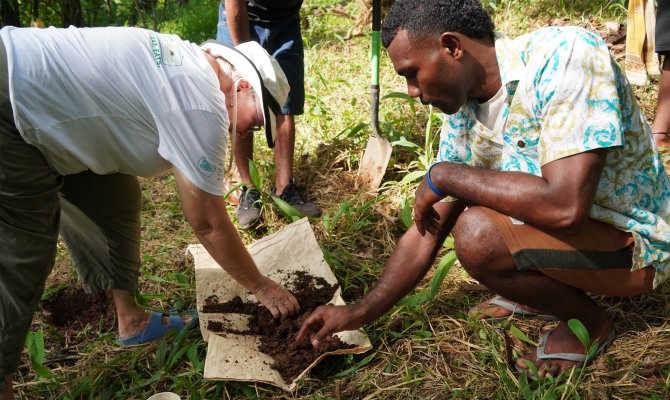
Mudrenicagi, Fiji - In many parts of Fiji, the signs of soil degradation are becoming harder to ignore. Farmers speak of declining soil fertility, increasing dependence on chemical fertilisers, and the gradual loss of biodiversity that once sustained their crops naturally. These changes are tied to a broader trend where conventional agriculture contributes to environmental degradation.
But for farmers on the island of Taveuni, these challenges are also deeply personal.
“We’re starting to see the harmful effects of chemicals on our land. You don’t always see it immediately, but over time, the soil changes,” said Mr Oliva Maiqalau, Vuna farmer and a member of the Kevin Young Farmers Alumni (KYFA) supported by the Pacific Ecosystem-based Adaptation to Climate Change (PEBACC+) project.
For others, like Tavuki organic farmer Mr Tomasi Sovealoka, the contrast between past and present is striking. “My father and grandfather never used chemicals,” he recalls. “They believed that if the soil is healthy, the food is healthy, and we are healthy. Because of them, the soil on our farm is still fertile today.”
Yet across Fiji, many farmers have moved away from these traditional practices over the past few generations. The introduction of chemical fertilisers promised higher yields, but often at the cost of long-term soil health and ecological balance.
The result is a growing tension on how to maintain productivity while restoring the land that farming depends on.
At Mudrenicagi Organic Learning Farm, part of the Pacific Organic Learning Farm Network (POLFN), a recent hands-on training and farmer-to-farmer learning addressed exactly this challenge. The three-day training that took place on 2-4 February 2026 helped farmers rethink how they interact with their environment. Rather than beginning with tools or techniques, the training started with a change in mindset.
“We want farmers to first understand the relationship between what they’re growing and the environment,” explained Ms Karen Mills, Trainer and Technical Farm Advisor for Mudrenicagi Organic Learning Farm. “To use their senses, to observe, and to recognise that what they grow directly affects the ecosystem around them.”
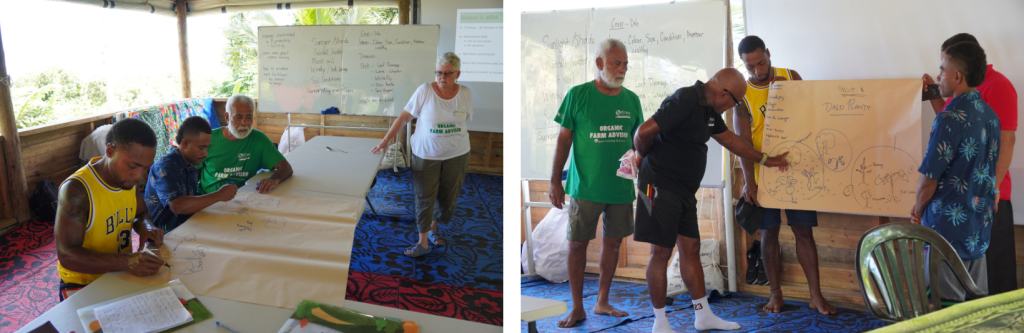
From this foundation, the training moved into practical solutions. Farmers learned how to rebuild soil fertility without chemicals, through composting, mulching, cover crops, and bio-fertilisers that offer short-term support while natural systems recover.
In regions like Taveuni, where steep terrain presents additional challenges, the training also focused on land management techniques such as contour planting, vetiver grass systems, and agroforestry. These approaches prevent erosion and improve long-term productivity.
Equally transformative is the approach to pest management.
“I don’t try to eliminate insects,” said Ms Mills. “I plant lots of plants that attract insects that are beneficial for my farm. I don’t spray anything, whether it's organic or not. I don’t have a problem with insects because my ecosystem is complete.”
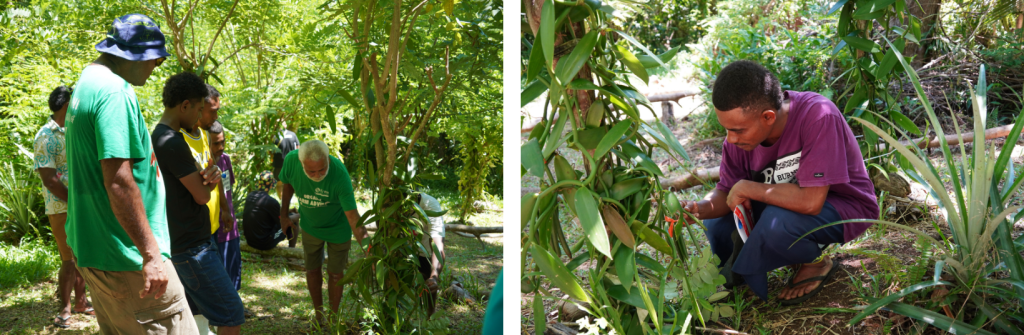
For participants, these lessons are both practical and empowering.
“This training has shown me how everything is connected, the land, the water, the air,” says Mr Sovealoka. “It’s encouraging, because we can take what we learn and apply it back home.”
The training is particularly distinctive because of the collaboration behind it. Tomasi, and seven KYFA farmers who joined the training are supported through the PEBACC+ project, funded by the Kiwa Initiative and the French Facility for Global Environment, and implemented by the Secretariat of the Pacific Regional Environment Programme (SPREP). Their participation in the training linked them to the POLFN project, another Kiwa Initiative implemented by the Pacific Community (SPC). The POLFN aims to develop an Organic Learning Farm network to address food security, climate change adaptation, and biodiversity conservation issues to strengthen the resilience of smallholder farmers in Fiji, Nauru, Tonga, and Solomon Islands.
In this shared space, two streams of work converge, one focused on building climate resilience and supporting young farmers, and the other on strengthening organic farming systems across the Pacific. The result is a training session and an exchange of knowledge, experience, and ideas.
Ms Loraini Sivo, PEBACC+ Project Manager with SPREP, notes that the collaboration is intentional and essential.
“Bringing farmers into spaces like the Organic Learning Farms allows knowledge to flow both ways. We are supporting climate resilience and strengthening local solutions by connecting farmers, projects, and traditional knowledge across the country and the region.”
She added, “For farmers attending through PEBACC+, the experience offers new tools to address the environmental challenges they are already facing at home.”
For Mr Wani Tavata and the KYFA Group, the training is only the beginning. “We’ve been wanting to learn these things,” he said. “Now we’ll go back and share this knowledge with other farmers. We want to restore our land,” said Mr Tavata.
The group plans to apply techniques such as intercropping, tree planting, and soil conservation approaches that improve productivity and protect the environment for future generations.
Oliva Maiqalau is already thinking about how to reshape his farm. “I used to focus on just taro and yaqona,” he said. “Now I’m adding fruit trees and thinking about agroforestry.”
In Fiji, the path toward sustainable agriculture may lie not in entirely new ideas but in reconnecting with old ones. Unlike large-scale industrial systems, Fiji’s small farms and the living memory of traditional practices offer a unique opportunity for change.
“We’re only a few generations removed from organic farming,” Ms Mills said. “That means we can bring those practices back, combine them with new knowledge, and see real improvements quickly.”
For farmers like Tomasi, this is already a reality. For others like Oliva and Wani, it is a future they are actively building.
Across these farms and communities, a shared understanding is taking root: caring for the soil is a commitment to the generations that will depend on it.
PEBACC+ is a regional project implemented by SPREP and funded by the Kiwa Initiative through its donors the European Union, Agence Française de Développement (AFD), Global Affairs Canada, Australian Government Department of Foreign Affairs and Trade (DFAT) and New Zealand Ministry of Foreign Affairs and Trade (MFAT), with co-financing from French Facility for Global Environment (FFEM). The project aims to develop, sustain, and institutionalize EbA approaches in Fiji, New Caledonia, Wallis and Futuna, Solomon Islands and Vanuatu.