

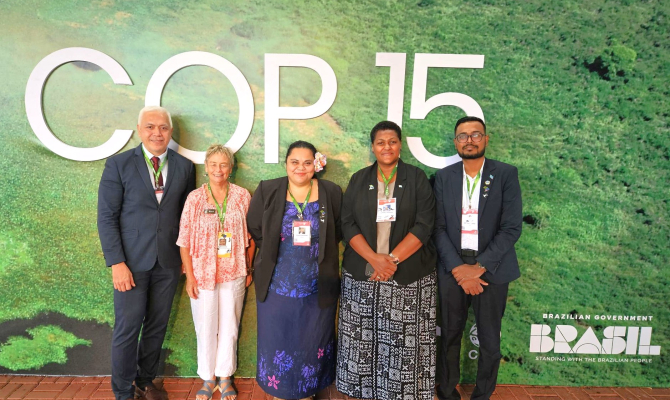
26 March 2026, Campo Grande, Brazil - As global attention turns to the 15th Meeting of the Conference of the Parties to the Convention on the Conservation of Migratory Species of Wild Animals (CMS COP15) in Brazil, a new report has warned that 49% of migratory species populations conserved by the global UN treaty are declining, and 24% of species face extinction.
The statistics are revealed in the review of the State of the World’s Migratory Species Report to be presented to COP15 this week. It has drawn the attention of Pacific delegates, who are in Campo Grande, Brazil, for one of the most important global meetings for wildlife conservation.
The Director of Cook Islands National Environment Service (NES), Mr Halatoa Fua, noted the report’s findings.
“The findings of the State of the World’s Migratory Species: Interim Report, including 49% of CMS‑listed migratory species populations are in decline and 24% of species are at risk of extinction, calls on states to accelerate implementation, including through adequate, and effective means of implementation for Small Islands Developing States,” he said.
“As stewards of Marae Moana, our ocean sanctuary spanning our entire Exclusive Economic Zone (EEZ), we stand ready to work with partners to safeguard migratory pathways, grounded in best available science and strengthened by community stewardship and traditional knowledge systems.”
Developed for CMS by the UN Environment Programme World Conservation Monitoring Centre (UNEP-WCMC) and other contributors, the interim report tracks significant changes in the conservation status of migratory species and highlights emerging trends.
The latest assessment found that 70 CMS-listed species had become more endangered over the previous three decades, compared to just 14 that improved in status. It also found that migratory fish populations had declined by 90% on average since the 1970s and 97% of CMS-listed migratory fish species face extinction. Even more alarming, the report found that more than half of Key Biodiversity Areas important for CMS-listed species lacked protected status.

Fiji’s Director of Environment, Department of Environment, Ministry of Environment and Climate Change, Ms Senimili Nakora – Baleicakau said: “Fiji has taken a significant step in protecting migratory seabirds by co-sponsoring a proposal at CMS COP15 to list 22 gadfly petrel species, including the rarest, most endangered and poorly understood Fiji Petrel (Kacau ni Gau) under CMS Appendices I and II.
“This move would strengthen legal protections and boost international cooperation for their conservation. Fiji’s involvement highlights its commitment to safeguarding these vulnerable species and Fiji underscores the importance of global collaboration, adequate financing, and resourcing, research and strengthened partnership with NGOs and local communities to protect migratory wildlife and their habitats.”
The CMS COP is a major UN treaty meeting, occurring every three years, that brings together international governments to manage and protect migratory animals and their habitats. Cook Islands, Fiji and Samoa are the Pacific countries represented. Other Oceania parties include New Zealand and Australia. The Secretariat of the Pacific Regional Environment Programme (SPREP) is providing support to Pacific delegations at CMS COP 15.

Ms Karen Baird, SPREP Threatened and Migratory Species Adviser, said the survival of migratory species depends on coordinated action across the full length of their migratory routes.
“In Oceania for example this affects our iconic marine migratory species such as turtles, whales, sharks and rays and seabirds,” she said.
“In Oceania, SPREP prepared a regional assessment of risk to marine turtles, which was referenced in the CMS interim global report which found 4/5 out our Pacific marine turtles are at threat of extinction this century due to a range of threats including overharvesting, bycatch, climate change and pollution.”
Another report to be presented in Brazil is the review of impacts of Deep Sea Mining on Migratory Species, following the adoption of resolution 14.6 at COP14 ‘Deep-sea mineral exploitation activities and migratory species’. The report notes that sediment plumes and wastewater discharges can disrupt animal navigation, feeding, and prey availability, and may introduce metal-contaminated particles into food webs.
The review indicates that almost half of marine mammals covered by the Convention could be impacted as well as other species groups.
CMS is a United Nations environmental treaty, in force since 1979, that promotes the conservation of migratory species, their habitats and migration routes on a global scale.
The Conference of the Parties (COP) is the main decision-making body of CMS, where 132 countries and the European Union meet to update the lists of species protected under the Convention, the CMS Secretariat budget and the resolutions that guide public policies and conservation initiatives worldwide.
The meeting takes place every three years. CMS brings together governments, scientists, Indigenous Peoples, local communities, civil society and wildlife experts to address challenges related to the conservation of migratory fauna at the global level. In total, approximately 1,189 species are listed in the CMS Appendices, including 962 birds, 94 terrestrial mammals, 64 aquatic mammals, 58 fish species, 10 reptiles and 1 insect.