

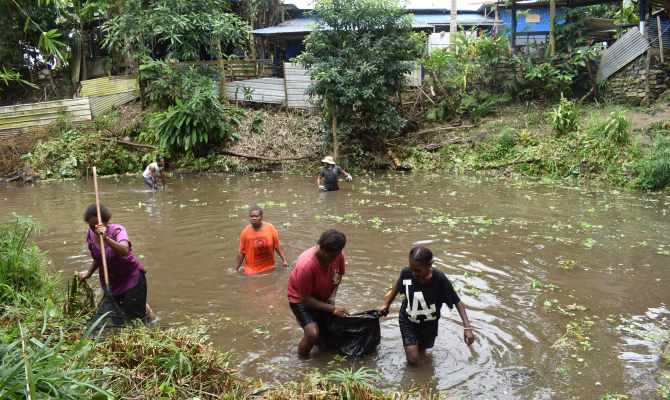
Give to Gain IWD 2026: As the world marks International Women’s Day 2026, women living along the Tagabe River in Vanuatu are showing how local leadership can restore ecosystems and strengthen communities. By organising clean-ups, mentoring youth, and restoring riverbanks, these women are turning environmental concern into collective action. Their efforts reflect this year’s theme, “Give to Gain,” showing how women’s time, knowledge, and commitment can create lasting benefits for both people and nature.
At the heart of this effort is the Green Environmental Network (GEN), a community-based organization working with the Pacific Ecosystem-based Adaptation to Climate Change (PEBACC+) project to restore and protect the Tagabe catchment through nature-based solutions.
A Community Network Rooted in Women’s Leadership
Although GEN was formally established just over a year ago, its origins lie in earlier work led by women in the community. According to founding member Ms. Touasi Kalsaria Tiwok, the idea grew out of environmental awareness efforts led by Emmy Tevi Siro, also a founding member, with women in the Northern Ward through the Northern Council of Women.
During her engagement with local communities, Emmy noticed the growing environmental pressures affecting families living along the Tagabe River. “She saw that women living along the Tagabe River were facing serious environmental challenges,” Touasi explains. “The communities needed support, not just along the river itself, but across the whole catchment.”
To coordinate action across the catchment, the Green Environmental Network (GEN) was formed. A later partnership with the PEBACC+ project helped expand this work and strengthen community efforts to restore the river. The PEBACC+ project is implemented by the Secretariat of the Pacific Regional Environment Programme (SPREP) and funded by the Kiwa Initiative and the French Facility for Global Environment.
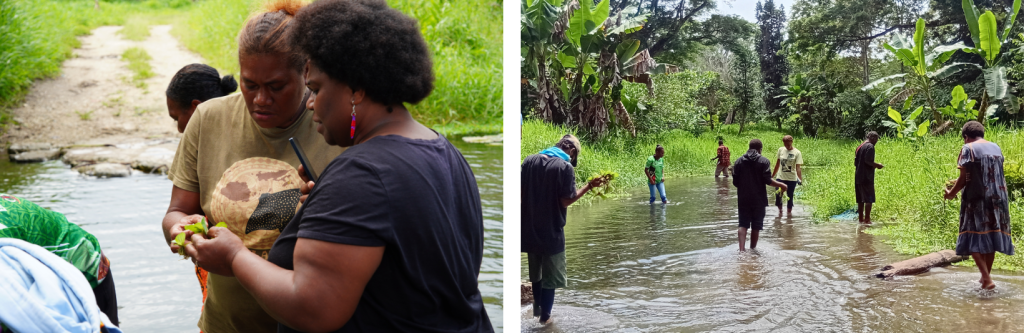
Today, GEN focuses on three core areas: organising community clean-ups to reduce waste, removing harmful invasive plants, and planting trees along riverbanks to protect the soil and water. To organise the work effectively, the lower Tagabe catchment has been divided into six areas covering around twelve communities, many of which depend directly on the river for their livelihoods.
Investing in Youth for Long-Term Change
“The question was how to reconnect them to the river,” Touasi says, “and help them see that it’s central to their daily lives.”
Through GEN, experienced women in the community are mentoring younger members, helping them understand both the ecological importance of the river and their role in protecting it. One of the young members was 22-year-old Virana Siro, who interned with the Biosecurity Department.
“I learned about invasive weeds, biocontrol agents, and how they affect the environment,” Virana explains. “We went into the field and learned about controlling the rhinoceros beetle in coconut trees and managing water hyacinth and water lettuce.”
After the internship, she began sharing what she learned with communities along the Tagabe River. “Many people living along the river didn’t understand what invasive species were, or how harmful they could be,” Virana says. “Now they understand that these plants damage the river ecosystem and affect marine life.”
Practical Action on the Riverbanks
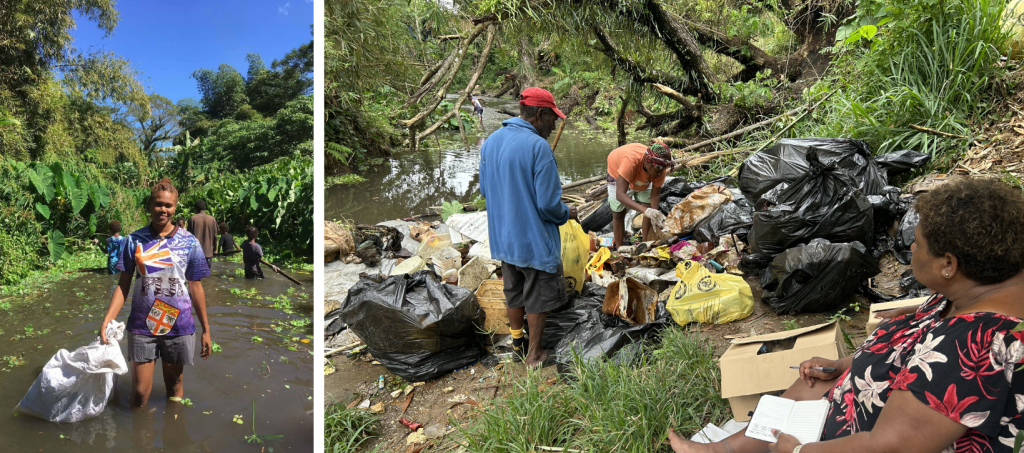
GEN’s first major awareness and clean-up activities took place in August 2025, combining learning with hands-on action. Community members worked in teams with different responsibilities. Some planted trees along the riverbanks to help stabilise the soil and protect the water. Others collected and sorted rubbish from the river and nearby areas. Another group recorded the types and amounts of waste collected.
The results were then shared with the community. “We showed them exactly how much rubbish had been thrown into the river,” Virana explains, “and explained why dumping waste there has to stop.”
Seeing the amount of waste collected helped people better understand the problem. In response, women in the community agreed to remove invasive weeds whenever they spotted them, showing growing ownership of the effort to protect the river.
Supporting Community-Led Solutions
For Mr. William Bani, PEBACC+ Country Coordinator for Vanuatu, the work being carried out by GEN demonstrates the power of community leadership.
“Women play a critical role in protecting the natural resources their families depend on,” he says. “What we see along the Tagabe River is a strong example of how supporting local women and youth to take action can lead to lasting environmental and community benefits.”
Bani notes that the partnership between the PEBACC+ project and GEN is designed to strengthen local capacity so that communities can continue managing their environment long after the project ends.
Lessons From the River
For Virana, the experience has shown how knowledge can change attitudes. “When people understand what invasive species are and how they affect the environment, they start to care more about the river,” she reflects. Virana’s interest has led her to the University of the South Pacific in Fiji, where she is now pursuing a Bachelor of Arts in Geography and Climate Change.
For Touasi, the partnership with the PEBACC+ project has reinforced the importance of community-driven solutions. “This work is grounding,” she says. “Real solutions take time. You can’t rush communities. When people understand why it matters, they ask for more engagement.”
Along the Tagabe River, women are not only restoring a damaged ecosystem, but they are building a model of community leadership rooted in knowledge, cooperation, and care for the environment. Their work shows how giving time, skills, and leadership today can create lasting gains for communities and nature alike.
PEBACC+ is a regional project implemented by SPREP and funded by the Kiwa Initiative through its donors the European Union, Agence Française de Développement (AFD), Global Affairs Canada, Australian Government Department of Foreign Affairs and Trade (DFAT) and New Zealand Ministry of Foreign Affairs and Trade (MFAT), with co-financing from French Facility for Global Environment (FFEM). This four-year project seeks to strengthen the resilience of ecosystems, economies, and communities to the impacts of climate change in Fiji, New Caledonia, Wallis and Futuna, Solomon Islands and Vanuatu.